


This is a review of The Well-Grounded Java Developer, Vital techniques of Java 7 and polyglot programming. Written by Benjamin J. Evans and Martijn Verburg. The book was published in July, 2012 and it contains 496 pages
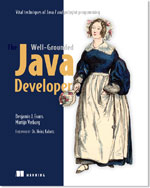 Right from the start I want to say that this is an excellent book and I highly recommend it. One thing you do need to be aware about is that in order to use this book you need to know Java. If you don’t know Java then this is not the book for you. This book is all about bringing you to the next level as a Java developer by showing you how to do continuous integration, dependency injection, testing, performance tuning, and more.
This book even shows you how to use different languages that run on the JVM. The book is written in a easy and concise style, everything is very clear. I also love the annotations which are sprinkled throughout the book, they give some nice background information. While the chapters on Groovy, Scala and Clojure are not a complete reference for the language, they do provide enough material to form a nice foundation, now you can further explore the language on your own.
The book is split up in four parts, I will list each part with the chapters within that part and will give a brief summary what the part is about
Part 1 Developing with Java 7
Chapter 1 Introducing Java 7
Chapter 2 New I/O
This section shows you what was added in Java 7, for example you can now use strings in switch statements, try-with-resources(similar to a using statement in c#, it frees up the resources after it is done). The Java IO stuff has been rewritten and much easier to use, where you had to write a whole bunch of code before, you can now do the same in much less code. Some things that did not exist in Java in terms of IO but now does exist are explained as well.
Part 2 Vital techniques
Chapter 3 Dependency Injection
Chapter 4 Modern concurrency
Chapter 5 Class files and bytecode
Chapter 6 Understanding performance tuning
This part has a lot of stuff and as a Java developer you should really know how this stuff works if you want to get to the next level. Dependency Injection(DI) and inversion of control (IoC) are covered, Guice 3, the reference implementation for DI in Java is also covered. Concurrency before Java 5 and concurrency now is covered. Concurrency will be a must now that we have multi-CPU and multi-core everywhere, you better get your wits around it. There is a whole chapter on the class files itself and how they are loaded as well as what they compile into. These are fun details and will show you exactly what happens when you compile and execute a class. Evereybody’s favorite subject performance tuning is covered in this part of the book as well.
Part 3 Polyglot programming on the JVM
Chapter 7 Alternative JVM languages
Chapter 8 Groovy: Java’s dynamic friend
Chapter 9 Scala: powerful and concise
Chapter 10 Clojure: safer programming
This is a very interesting part of the book and I would suggest not to skip it. There are 3 type of languages covered in this part:
Groovy, a dynamic language
Scala, a functional language
Clojure, a Lisp for functional programming
Take a look at these languages and you will be amazed how much Java boilerplate code you can eliminate by using these languages instead. Some of the functional is a little bit of a paradigm shift and you might need some time adjusting. You will also see how you can interoperate between these languages and Java.
Part 4 Crafting the polyglot project
Chapter 11 Test-driven development
Chapter 12 Build and continuous integration
Chapter 13 Rapid web development
Chapter 14 Staying well-grounded
The last part is all about automation and making your life easier. If you are a developer who still deploys stuff by using FTP to move JAR, EAR and WAR files, pay attention. Maven is covered as the build automation tool, Jenkins is the continuous integration tool. In the Rapid web development chapter Grails is explored.
- * *Let me just repeat again that I think this is an awesome book and as a Java developer you have to check it out. The one thing that is missing from the book is ORM, it is covered a little in the testing chapter but if you want to know about ORM, you will need to pick out some other book just for that.
You can download the following chapters to get a feel for the book
Head on over to Amazon for other reviews of The Well-Grounded Java Developer, Vital techniques of Java 7 and polyglot programming
The site for the book can be found here: http://www.manning.com/evans/
- * *Below is the complete table of contents so that you have a little more details about each chapter.
**Part 1 Developing with Java 7
Chapter 1 Introducing Java 7
** The language and the platform
Small is beautiful—Project Coin
The changes in Project Coin
Summary
Chapter 2 New I/O
Java I/O—a history
Path—a foundation of file-based I/O
Dealing with directories and directory trees
Filesystem I/O with NIO.2
Asynchronous I/O operations
Tidying up Socket-Channel functionality
Summary
**Part 2 Vital techniques
Chapter 3 Dependency Injection**
Inject some knowledge—understanding IoC and DI
Standardized DI in Java
Guice 3—the reference implementation for DI in Java
Summary
Chapter 4 Modern concurrency
Concurrency theory—a primer
Block-structured concurrency (pre-Java 5)
Building blocks for modern concurrent applications
Controlling execution
The fork/join framework
The Java Memory Model (JMM)
Summary
Chapter 5 Class files and bytecode
Classloading and class objects
Using method handles
Examining class files
Bytecode
Invokedynamic
Summary
Chapter 6 Understanding performance tuning
Performance terminology—some basic definitions
A pragmatic approach to performance analysis
What went wrong? Why we have to care
A question of time—from the hardware up
Garbage collection
JIT compilation with HotSpot
Summary
**Part 3 Polyglot programming on the JVM
Chapter 7 Alternative JVM languages
** Java too clumsy? Them’s fighting words!
Language zoology
Polyglot programming on the JVM
How to choose a non-Java language for your project
How the JVM supports alternative languages
Summary
Chapter 8 Groovy: Java’s dynamic friend
Getting started with Groovy
Groovy 101—syntax and semantics
Differences from Java—traps for new players
Groovy features not (yet) in Java
Interoperating between Groovy and Java
Summary
Chapter 9 Scala: powerful and concise
A quick tour of Scala
Is Scala right for my project?
Making code beautiful again with Scala
Scala’s object model—similar but different
Data structures and collections
Introduction to actors
Summary
Chapter 10 Clojure: safer programming
Introducing Clojure
Looking for Clojure—syntax and semantics
Working with functions and loops in Clojure
Introducing Clojure sequences
Interoperating between Clojure and Java
Concurrent Clojure
Summary
**Part 4 Crafting the polyglot project
Chapter 11 Test-driven development
** TDD in a nutshell
Test doubles
Introducing ScalaTest
Summary
Chapter 12 Build and continuous integration
Getting started with Maven 3
Maven 3—a quick-start project
Maven 3—the Java7developer build
Jenkins—serving your CI needs
Code metrics with Maven and Jenkins
Leiningen
Summary
Chapter 13 Rapid web development
The problem with Java-based web frameworks
Criteria in selecting a web framework
Getting started with Grails
Grails quick-start project
Further Grails exploration
Getting started with Compojure
A sample Compojure project—”Am I an Otter or Not?”
Summary
Chapter 14 Staying well-grounded
What to expect in Java 8
Polyglot programming
Future concurrency trends
New directions in the JVM
 Denis has been working with SQL Server since version 6.5. Although he worked as an ASP/JSP/ColdFusion developer before the dot com bust, he has been working exclusively as a database developer/architect since 2002. In addition to English, Denis is also fluent in Croatian and Dutch, but he can curse in many other languages and dialects (just ask the SQL optimizer) He lives in Princeton, NJ with his wife and three kids.